One Step Now Education
October 30, 2026
apparition
In continuing our look at words related to Halloween, let’s examine this word. I’ve studied the <pare> family before, home of relatives like prepare and separate. Is this connected?
What concepts will we summon in this investigation? How about another look at modifiers, specifically those that are present participles? We need to take a examine assimilated prefixes and perhaps a Latin stem suffix as well. We’ll check out how the Latin infinitive helps us with the English base. Before we end, we’ll need to sort out a morphological relative from an etymological relative and find out what Frenchifiedmeans. The last thing before this investigation disappears is check-in with palatalization.
Meaning
What is this word’s meaning and how does the word function?
Last time, our student was reading a story about Mara. Let’s keep reading.
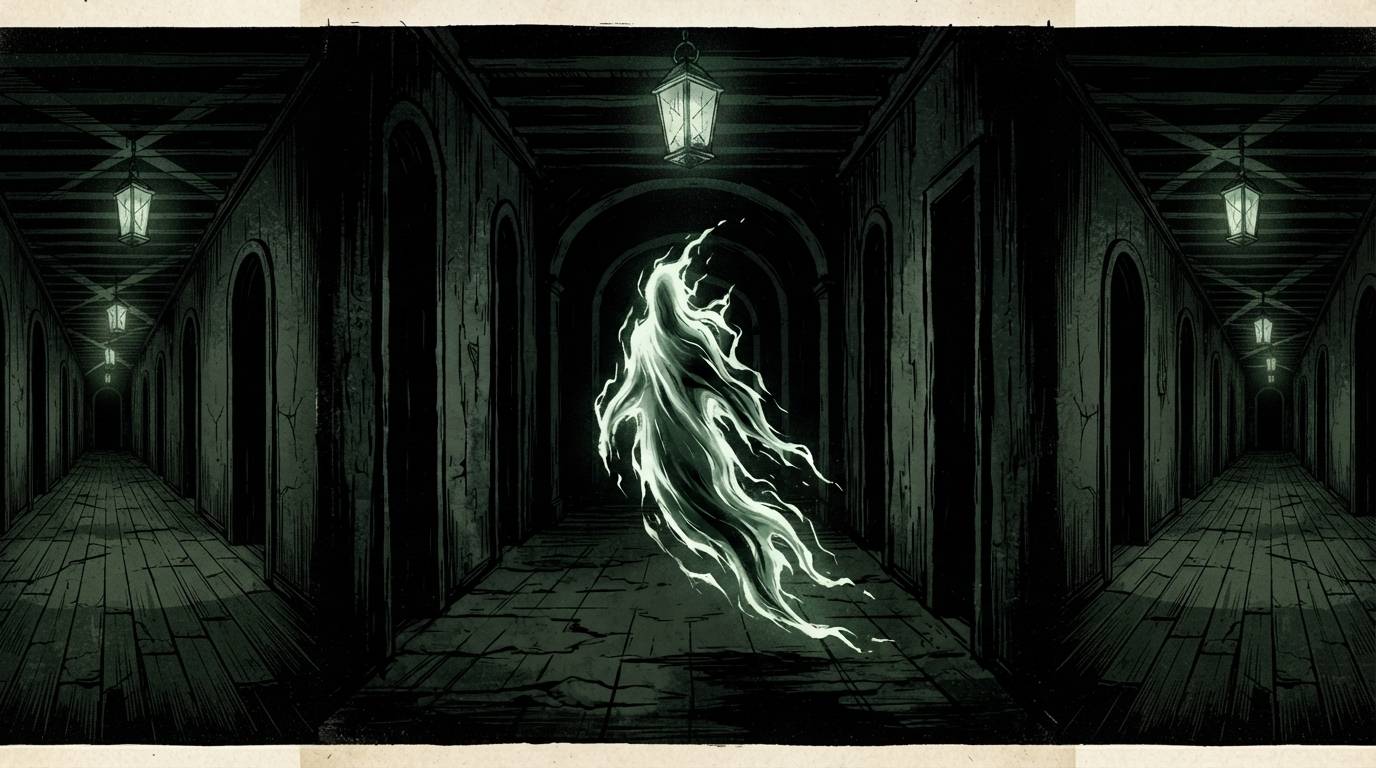
A sinister laugh echoed through the empty hallway, making Mara freeze in her tracks. Trembling, Mara turned toward the sound and saw a pale apparition drifting down the corridor, its edges flickering like candlelight.
Now we have even more context to help us decipher what an apparition is.
An apparition is something that drifts or flickers. Typically, we think of words that end in the suffix <-ing> as verbs, but is that what’s going on here?
The first phrase, “drifting down the corridor,” modifies apparition. The second phrase, “flickering like candlelight,” modifies edges. We often think of modifiers as appearing before the noun they modify; however, when longer, they often appear after the noun. Words ending in <-ing>, or present participles, can do more than simply show the progressive tense of verbs.
Let’s come back to our word apparition.
From those words, we get the sense that an apparition is something that isn’t quite human, with its driftingand flickering. The Collins dictionary tells us apparitions are “something you see or think you see but who is not really there as a physical being.” It gives us several synonyms, including ghost and spirit.
So why would the author not choose ghost or spirit instead?
It may be because the author wanted to have the reader focus on the way it showed up rather than what it was. It may be because the author wanted the tone to be even more mysterious to a reader who knows what a ghost is. It may even be that the author had used the words ghost and spirit recently in the text and just wanted to use a different term.
Authors select the words they use to convey a sense and meaning.
Structure
What are the elements that make up this word’s structure?
So, let’s talk briefly about something I am still seeing with my students. Look at this hypothesized suffix:
appari + tion
I have yet to truly analyze a word and find a <-tion> suffix, but it is still taught in schools. When we use the tool of a word sum, we can easily falsify this letter string as a suffix:
ac + tion ???
act + ion ✔
vaca + tion ???
vacate/ + ion ✔
So, let’s modify that earlier hypothesized word sum:
apparit + ion
I’m also wondering about those two <p>’s at the beginning of the word. I’ve often found that a repeating letter at the beginning of a word can be a sign of an assimilated prefix.
ap + parit + ion
An assimilated prefix has been respelled to make it easier to pronounce. An <ad> prefix can change its final consonant to match the first letter of the base it attaches to:
af + ford –> afford
as + sign –> assign
al + lure –> allure
Notice in each of those word sums that the prefix is already spelled as the version used in the final word. Assimilation occurred in the journey from Latin times; it is not a Present-Day English orthographic change, like the suffixing conventions of replacing an <e> or doubling a final consonant. There is no adford we have to change to afford when we construct our word sum.
So let’s take a look at Etymonline to get some more information about the history of this word. We can also use information found there to help us ascertain the base.
Like sinister, this word came to us in the early 15th century, the Middle English period. The entry goes on to tell us our word was first borrowed from Anglo-French. Anglo-French was the French from the Norman Invasion. Around the time of the Norman Invasion, the French language that was spoken in the Northern part of the country differed from the French that was spoken in the south of France. The word they had came from Old French and referred to the Epiphany, which was when the Wise Men visited Jesus.
In Classical Latin, which is the Latin we often are looking at in word study, the meaning was related to “appearance” or “attendants.” The Latin verb was apparere, “to appear.”
I know this word is a Latin verb because it ends in <ere>, a Latin infinitive suffix. The Latin infinitive suffix can be an <-ere>, an <-ire>, or an <-are> when you are looking on Etymonline. When we remove the suffix, we can obtain our English base, <appar>.
Two things.
First, we have to add an <e> to our base. Otherwise, when we add a vowel suffix, like <-ition>, we would have to double that <r>, and we don’t see that in this word:
appare/ + ition
Second, the entry tells us to see appear. There, we learn about the assimilated prefix we suspected before:
ap + pare/ + it + ion
Finally, let’s look at that <it>. What’s that about?
If you looked in a Latin dictionary resource like Lat-Dict, you would see the following principal parts of this Latin verb:
adpareo, adparere, adparui, adparitus
We already discussed the infinitive form; that’s the second principal part. We rarely use the first and third principal parts to determine the English base. The fourth principal part, also known as the past participle form, can also be the source of an English base. From this form, we remove the suffix <us> to obtain our base.
Sometimes we can also remove the <it>, which is known as a Latin stem suffix. A Latin stem suffix will have some element appear prior to it, and something will also appear after it. In the instance of adparitus, the <par> appears before and the <us> after.
Keep that Lat-Dict bookmarked. It may provide help with your word sums.
Relatives
What are the word’s relatives and history?
Now that we have determined the elements in this word, we can begin looking for relatives. A morphological relative shares the same spelling as the base <pare> and traces back to that parere root, “come forth.”
We can find many relatives by putting parere in the search engine of Etymonline. We can then look at all the entries to see if those words also have a <pare> spelling of the base and an origin in parere.
The first entry we get is appear. This is obviously related. The entry says that it comes from parere. However, the base of this word is not the same; therefore, this is known as an etymological relative, a relative that shares a root, but not the base. Other etymological relatives include disappear and reappear.
That <pear> base was Frenchified. We see that as the word moved from Latin and through French on its journey to English, the French modified it to match its own orthography. Then we had to do the same in English. We see this with many words we received in the Norman Invasion.
We have transparent, a great word that pairs up nicely in meaning with apparition. That same root also gives us apparent. Earlier I asked if it was related to prepare and separate. If I go search the entries for those words, I see they are from a Latin verb parare, “make ready.” If you remove the Latin infinitive suffix from that verb, you have a homographic base <pare>. These words are not related. Some who practice scientific word study will use these as “ringers” or “foils.” Sometimes we know what is in the family by carefully considering what’s not in the family. A word must have the spelling of the base and the same root to be in a family.
Graphemes
What can the pronunciation of the word teach us about the relationship of its graphemes and its phonology?
The word apparition gives us a great example of palatalization, the sound change that happens as the tongue moves back towards the soft palate when pronouncing a word. We pronounce the <t> that appears just before the suffix as /ʃ/. As a result, students might misspell it with an <sh>. Students may do this because they’ve been taught that /ʃ/ is the “<sh> sound.” I work to be careful with my language to prevent this confusion. I refer to this sound by simply pronouncing it when I speak to students, as I do with all “sounds.” I also make sure early on to familiarize my students with the idea that a <t> can spell /ʃ/, like in words with the false suffix <tion> or in words like partial or cautious.
An important concept in the English orthographic system is that graphemes cannot cross morphemic boundaries. Graphemes make up the elements we use to build words. In apparition, the <t> belongs to that stem suffix <-it->, not that final suffix <-ion>. This also explains why there is not a <ti> digraph, as I’ve seen taught in places.
Teaching students to decode in syllables may get them reading quickly, but then it trips them up when spelling. This may be why some teach a false <tion> suffix.
Next Steps
What concepts from this investigation can we explore next to learn more about the English orthographic system?
Do your students still see <tion> as a suffix? Remember that word sums are great tools for helping to verify the elements that build a word.
Are your students proficient with how to obtain an English base from a Latin verb? Can you show them how to remove the infinitive suffix?
You and your students might do a syntax study where you look at how present participles function in different sentences. Are they part of the predicator or are they modifying a noun?
I was prepared for one kind of connection, but that disappeared upon seeing the root. Just as I once taught there was a <-tion> suffix, what seems apparent isn’t always the case.
Stay curious,
Brad
Join the community!
PS. The second volume of Investigating English Spelling will include an investigation to look further at assimilated prefixes. In the meantime, the first volume is here.
Taking the Next Step
In this monthly addendum to the WIN, we look at ways to teach students how to study words scientifically.
Let’s take a further look at form and function.
A quick way to think about is that form is “what it’s made of” and function is about “what it does.”
Let’s look at our paragraph again from above:
A sinister laugh echoed through the empty hallway, making Mara freeze in her tracks. Trembling, Mara turned toward the sound and saw a pale apparition drifting down the corridor, its edges flickering like candlelight.
Both of these sentences contain participle phrases:
“making Mara freeze in her tracks”
“trembling”
“drifting down the corridor”
“flickering like candlelight”
They are called this because they each begin with a participle.
However, they are not all doing the same thing. They function differently.
The first participle phrase is functioning as an adverbial. An adverbial can describe how the entire clause operates. The second phrase (yes a single word can be a phrase!) is also adverbial, describing how Mara turned. Trembling isn’t telling you which Mara.
The last two phrases are modifying. They cannot be separated from the nouns they modify, apparition and edges. They tell you what kind of apparition and which edges.
So how might we prepare a lesson on teaching the function of adverbials and modifiers?
These are relational concepts. Their function is about their relationship to the sentence and the words within. Therefore, we cannot count on instruction that just presents phrases absent of the context in which they’d appear.
We might give them a stack of similar sentences and have them sort what the underlined phrase in each is doing. We might also see if we can move around the phrase. Adverbials can move; modifiers appear before or after the item they modify.
Trembling, Mara turned toward the sound.
Mara turned toward the sound trembling.
For each type of phrase, we can practice our authorial skills by swapping out with similar phrases. What are other ways Mara can turn toward the sound, beginning with a participle?
Shaking, Mara turned toward the sound.
Sobbing, Mara turned toward the sound.
And what if we wanted to show a sudden movement of bravery in our story instead?
Steeling herself, Mara turned toward the sound.
We still used a participle phrase. Teaching students to identify the form of these phrases as participles is an exercise, but teaching them how to understand function instead can empower them to make more interesting authorial choices.
One Step Now Education
600 1st Ave, Ste 330 PMB 92768, Seattle, WA 98104-2246
Unsubscribe · Preferences
