One Step Now Education
August 21, 2026
rambunctious
Are you feeling a little rambunctious?
Are you feeling connections to ramshackle or rumpus?
Words that share similar sounds often get associated in our minds. However, this doesn’t always mean they share etymological roots. We must investigate to find that out.
In this investigation, we’ll look at how context clues can help with understanding the meaning of a word. We’ll look at a derivational suffix that signals the word’s class. A long, twisty journey will land us in a description of palatalization for our final question.
Meaning
What is this word’s meaning and how does the word function?
In most of the work I do with students, we are often reading something together and when we run across a word that looks interesting or generative, I might point it out. Let’s pretend I’m reading the following paragraph with a rising third grader:
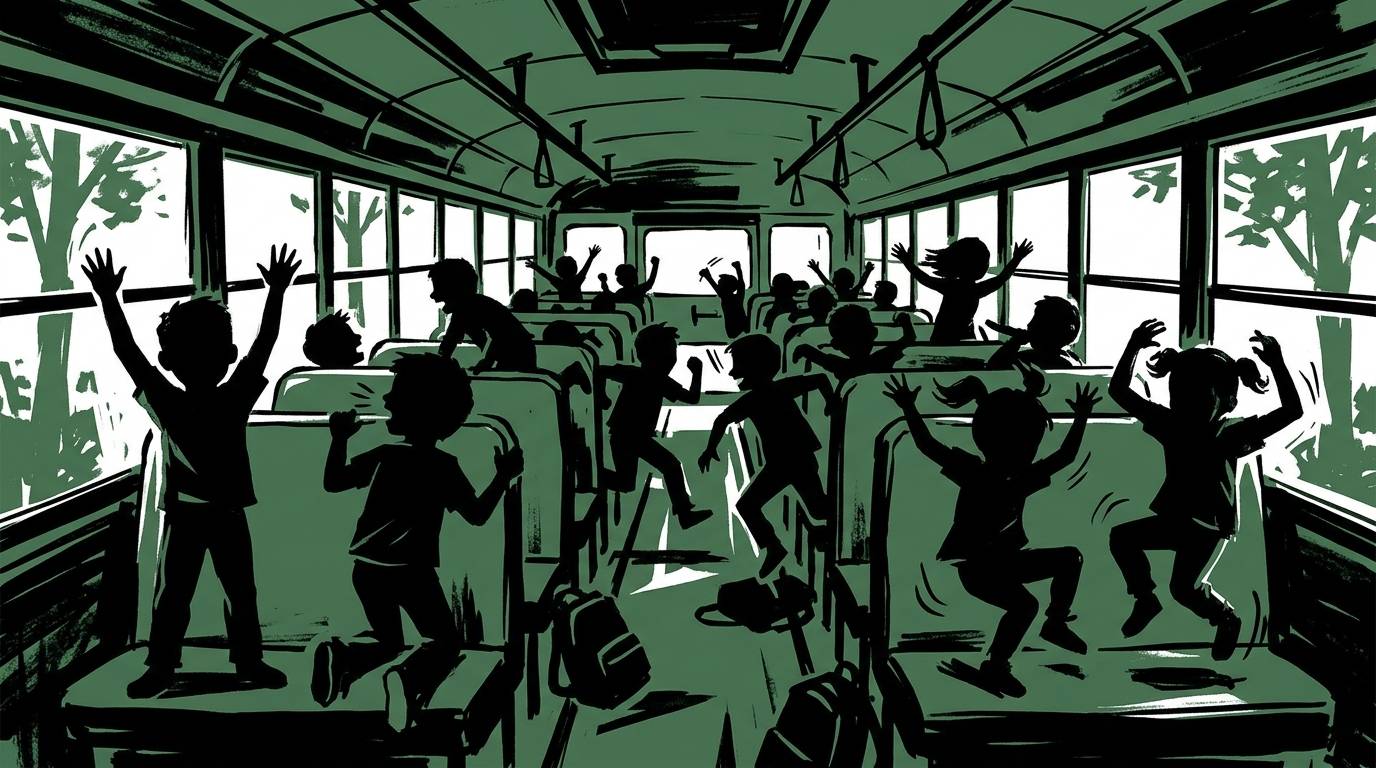
After three hours on the bus, the entire class was absolutely rambunctious. They were shouting over each other, laughing at everything, running up the aisle and bouncing on the seats. When they finally arrived at school, the teacher marched them straight to the playground.
“Oooh, now there’s an interesting word,” I might start, pointing out rambunctious. I may ask them to Spell It Out, a process whereby a student announces the affixes and graphemes in sequence, each getting one beat. Since I’m not sure of the graphemes and affixes in this word myself, I may alternatively ask, “What do you think that means? What’s rambunctious?”
“I don’t know.”
Does that sound like students you have? “I don’t know” is a call for a cue to jog their brain.
“I’m thinking about the clues in the paragraph. How would you feel after three hours on a bus?”
“Bored.”
“Me too. Does it say they were sitting there bored?”
“No it says they were shouting and laughing.”
“Yeah, and running and bouncing all over the seats. All of those things are examples of being rambunctious. Authors sometimes give us example context clues.”
Teaching context clues, in my opinion, is something I don’t hear too many people talking about these days. I wonder if it’s too closely related to the idea of the “three-cueing system” that’s been banned in most states. The truth is we learn far more words implicitly through context clues than we ever do explicitly in instruction. I’m doing a little of both here. I’m teaching about the word rambunctious explicitly, but I’m also referring to context clues, like example clues, to help them with independent learning later.
“So would you say rambunctious means tired or rowdy?” I probe. Sometimes scaffolding with a choice can help a student who is stuck on expressive language.
The entry in the Collins dictionary says to be rambunctious is to be “energetic in a cheerful noisy way.” It also says in Britain, to use rumbustious, which is a new word for me.
Either way, both of those words have a structural component that tells me the word is an adjective.
Structure
What are the elements that make up this word’s structure?
The suffix <-ous> is one of the first derivational suffixes I teach to students. Derivational suffixes are suffixes that may change a word’s class.
rambunct + i + ous
We see that suffix in words like curious or generous. In curiosity it also has the same connecting vowel letter <i>. This suffix has another form, <-ose>, that you’ll see in curiosity or generosity. The suffixes <-ous> and <-ose> are allomorphs. Allomorphs are variants of the same form that appear in different phonological contexts. The form <-ose> appears in stressed positions and is frequently followed by the construction <-ity>.
The <-ous> derivational suffix also reliably creates adjectives. But from what form though? What is <rambunct>? Let’s head over to an etymological dictionary, like Etymonline, to look at this word’s history.
The entry tells us this word was a rather late entry into our language (1834). It also says that it is probably altered from rumbustious. We are urged to compare rantankerous, and it is a variant of cantankerous.
What should we make of all that?
Let’s follow that link to rumbustious.
For rumbustious, the entry says its an “arbitrary formation.” This suggests the word was made-up. We see that it may have been compounded with an intensive prefix <ram> or <rum>. I’ve not seen those prefixes before, but it says that the word is “suggested by” boisterous or bumptious. At the end of the entry it says to compare ramshackle, the earlier connection I had made.
What say we follow that entry as well?
The word ramshackle came around 1809 and may have been related to ransack. There’s a whole network of these colloquialisms, and they seem to have led here. From a Scandinavian resource, the entry for ransack is our earliest entry, coming in the mid 13th century. It is from a word meaning “plunder.”
What do we do with a word sum when something is an “arbitrary formation?” I think in this instance, we have a clear element <-ous> preceded by a connecting vowel letter. However, I’d keep the rest of the word intact, despite a historical prefix <ram->.
rambunct + i + ous
Relatives
What are the word’s relatives and history?
Given that the word has an arbitrary formation, there probably won’t be a ton of relatives. Certainly we can refer to someone’s rambunctiousness. We can also say someone is behaving rambunctiously.
Graphemes
What can the pronunciation of the word teach us about the relationship of its graphemes and its phonology?
Perhaps the most interesting part of this word’s phonology is what is happening at the juncture of the base and the connecting vowel letter. The connecting vowel letter <i> can palatalize the preceding consonant. We see this in the following words:
part + i + al –> partial
music + i + an –> musician
fract + i + ous –> fractious
Similar to fractious, rambunctious has the grapheme <t> spelling /ʃ/. Palatalization can occur when a front vowel triggers the consonant to be articulated near the hard palate. Run your tongue from the back of your teeth along the roof of your mouth. That part of the roof before you hit the soft palate is your hard palate.
Next Steps
What concepts from this investigation can we explore next to learn more about the English orthographic system?
You might go deeper with other types of context clues like synonym clues or contrast clues.
Some prefixes are allomorphs. When do you notice we use a prefix <red->, as in redolent vs. <re->? When do you notice the use of <ir-> or <il-> instead of <in->?
What are other words you and your student can collect where the previous consonant is palatalized by a connecting vowel letter <i>?
I used to be upset when I investigated a word, and there wasn’t a clear answer with a Latin verb that I could peel the suffixes off of and arrive at my English base. Now, I just marvel at the journey. The history of the word rambunctious was just as unruly as the definition of the word itself.
Stay curious,
Brad
PS. If you have a colleague who’d appreciate knowing a little more about palatalization or allomorphs, pass this newsletter along. They can then sign up to receive these every week at the link underneath my photo.
PPS. The <i> isn’t the only connecting vowel letter that triggers palatalization. Do the word sums for the words gradual and educate.
One Step Now Education
600 1st Ave, Ste 330 PMB 92768, Seattle, WA 98104-2246
Unsubscribe · Preferences
